PLR vs MRR vs Resell Rights: Which One Is Best for Your Business
Table of Contents
1. What Are Digital Product Rights?
5. PLR vs MRR vs Resell Rights: Main Differences
6. Which One Is More Profitable?
7. Which One Is Best for Beginners?
If you want to sell digital products online, you will quickly run into three common license types: PLR, MRR, and Resell Rights. They sound similar, but they are not the same. Choosing the wrong one can limit how much you earn, how much freedom you have, and how easily you can build a real brand around the product.
This guide will explain the difference between PLR, MRR, and Resell Rights in a simple, practical way. More importantly, it will help you decide which one is best for your business, especially if your goal is to sell digital products, build an email list, create offers, launch funnels, or grow a long-term online brand.
PLR vs MRR vs Resell Rights: Which is more profitable for beginners in 2026
What Are Digital Product Rights?
Digital product rights explain what you are legally allowed to do with a product after buying it. For example, you may buy an ebook, course, template, worksheet, video package, article pack, or coaching resource. But buying the product does not always mean you can edit it, rebrand it, resell it, or give resale rights to someone else.
This is where many beginners make mistakes. They assume that every digital product can be sold however they want. That is not true. The license matters more than the product itself.
For example, two people may buy similar ebooks about productivity. One ebook may come with personal-use rights only, meaning the buyer can read it but cannot sell it. Another ebook may come with PLR rights, meaning the buyer can edit it, rebrand it, turn it into a lead magnet, sell it as a product, or use it inside a course. The content may look similar, but the business opportunity is completely different.
If you want a deeper beginner-friendly explanation of private label rights, read this pillar guide: What Are Private Label Rights Products and How Do They Work for Beginners?
What Is PLR?
PLR stands for Private Label Rights. This is usually the most flexible type of digital product license. When you buy a PLR product, you are typically allowed to edit the content, change the title, add your branding, redesign the product, combine it with other resources, and sell it as your own.
This is why PLR is powerful for online business owners, coaches, bloggers, course creators, freelancers, and digital product sellers. You are not starting from zero. You are buying a ready-made foundation and turning it into something that fits your audience.
For example, if you buy a PLR course about content marketing, you can rebrand it for small business owners, coaches, freelancers, or creators. You can turn the lessons into a mini-course, email series, webinar, lead magnet, workshop, paid ebook, or membership content. That flexibility is what makes PLR valuable.
Difference between PLR, MRR, and resell rights with real examples
Recommended PLR Product Example
Content Marketing 101 PLR Crash Course
This is a strong example of a PLR-style product because it provides ready-made educational content you can use to create offers, coaching resources, lead magnets, or training materials for your audience.
The biggest advantage of PLR is control. You are not just reselling the same thing as everyone else. You can improve the product, add your own examples, create a stronger offer, package it differently, and make it feel original.
This matters because most people who fail with PLR fail for one simple reason: they upload the product exactly as they bought it. That is lazy selling. A smarter seller uses PLR as raw material. You customize it, improve it, and make it more useful for a specific audience.
What Is MRR?
MRR stands for Master Resell Rights. With MRR, you can usually resell the product and also pass resale rights to your customers. That means your customers may also be allowed to sell the same product after buying it from you.
This can sound exciting at first because it creates a “business in a box” feeling. You buy a product, resell it, and tell buyers they can resell it too. That can work well for certain markets, especially when the product is positioned around making money online, selling digital products, side hustles, or beginner business education.
But here is the problem: MRR products can become oversaturated quickly. If every buyer can also resell the same product, the market can fill up with identical offers. When that happens, sellers compete on price instead of value. That usually leads to weaker profits and lower trust.
MRR can still be useful, but you need to be careful. It works best when you build a strong funnel, add bonuses, create your own training, and make the offer feel different from what everyone else is selling.
What Are Resell Rights?
Basic Resell Rights allow you to sell the product to customers, but you usually cannot edit the product or pass resale rights to your buyers. Your customer buys the product for personal use, not to resell it.
This is the simplest license type, but also the most limited. You can sell the product, but you may not be able to change the name, rewrite the content, add your branding, or reposition it for your audience.
Basic Resell Rights can be a good option if you want a simple product to add to your store quickly. But if you want to build a serious brand, create unique offers, or use content in multiple ways, it may feel restrictive.
Think of basic Resell Rights like buying a product from a wholesaler and reselling it as-is. Think of PLR like buying the raw material and creating your own branded version. One gives you speed. The other gives you control.
PLR vs MRR vs Resell Rights: Main Differences
The main difference between PLR, MRR, and Resell Rights comes down to control.
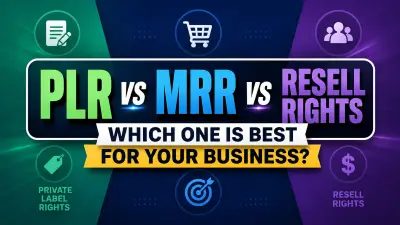
PLR gives you the most freedom. You can usually edit, rebrand, repurpose, and sell the product under your own brand. MRR lets you resell the product and often lets your buyers resell it too. Basic Resell Rights usually allow you to sell the product, but not edit it or transfer resale rights.
Here is the practical difference:
| License Type | Can You Edit It? | Can You Resell It? | Can Buyers Resell It? | Best For |
|---|---|---|---|---|
| PLR | Usually yes | Usually yes | Depends on the license | Brand building, funnels, courses, and content marketing |
| MRR | Usually limited | Yes | Usually yes | Resale offers and business opportunity products |
| Resell Rights | Usually no | Yes | Usually no | Simple product resale |
For most beginners, PLR is the best long-term choice because it allows you to create something that feels unique. MRR can sell fast when the offer is hot, but it can also become crowded. Basic Resell Rights are useful, but they give you the least control.
Build Your Digital Product Store Faster
Want ready-made digital products, PLR resources, courses, bundles, and business content you can use to build offers faster?
Which One Is More Profitable?
Can you make money with PLR vs MRR vs resell rights products
The most profitable license depends on your strategy. But in most cases, PLR has the highest long-term profit potential because you can build multiple assets from one purchase.
For example, one PLR course can become a paid ebook, mini-course, email sequence, blog series, workshop, coaching resource, lead magnet, and bundle. That means you are not limited to one product page. You can create an entire funnel around the content.
MRR can also be profitable, especially when buyers want a product they can resell immediately. But the challenge is differentiation. If many sellers are promoting the same MRR product with the same sales page, the product becomes weaker over time.
Basic Resell Rights can generate sales, but the ceiling is usually lower because you cannot do much to improve the offer. You may be stuck selling the same thing as others, with the same title, cover, and positioning.
Here is the simple business view:
If you want fast resale, MRR, and basic Resell Rights can work. If you want a flexible asset you can shape into a real brand, PLR is usually better.
For a beginner, a realistic path might look like this:
In the first month, you buy a quality PLR product, customize the title, improve the cover, add a checklist, and sell it as a low-ticket product. In the second month, you turn part of it into a lead magnet and build an email list. In the third month, you bundle it with another PLR product and create a higher-value offer. That is how PLR becomes more than a product. It becomes a system.
Which One Is Best for Beginners?
Best type of resell rights for selling digital products online
For most beginners, PLR is the best starting point because it gives you freedom and room to learn. You can practice branding, copywriting, product positioning, email marketing, and funnel building without creating every piece of content from scratch.
That does not mean PLR is magic. You still need to do the work. You need to choose a good niche, understand your audience, improve the content, create a strong product page, and drive traffic. But PLR reduces the hardest part: starting from a blank page.
MRR is better for beginners who want to sell a clear “resell this product” opportunity. But beginners often make the mistake of thinking MRR sells itself. It does not. You still need trust, traffic, proof, bonuses, and a good offer.
Basic Resell Rights are best for beginners who want a simple product to test. But they are not ideal if your goal is to build a strong brand. You have less freedom to customize and less ability to stand out.
If you are building a serious online business, choose PLR first. Use MRR carefully. Use basic Resell Rights only when the product fits your audience and the license terms are clear.
Best Category to Explore
If you want products for courses, coaching, content marketing, lead magnets, and digital product offers, start with business and marketing resources.
How to Choose the Right License
Before buying any PLR, MRR, or Resell Rights product, ask one question: “What do I want to build with this?”
If you only want to sell the product once, basic Resell Rights may be enough. If you want to sell the product and give your customers the right to resell it as well, MRR may be a good fit. But if you want to create a brand, build funnels, grow an audience, and turn a single product into multiple assets, PLR is usually the better choice.
You should also read the license carefully. Not every PLR license is the same. Some allow full editing and branding. Some restrict marketplaces. Some do not allow you to pass PLR rights to your customers. Some allow personal branding but not the transfer of resale rights. Always check what is allowed before promoting the product.
Here is the mistake many beginners make: they focus only on the product topic and ignore the license. That is dangerous. A beautiful product with a restrictive license may be less useful than a simple product with flexible rights.
Also, think about your audience. If your audience is coaches, consultants, freelancers, small business owners, creators, or educators, PLR courses and templates can be very powerful. These buyers do not just want information. They want content they can use quickly to save time, serve clients, and create offers.
PLR vs MRR vs resell rights for passive income and automation
If your goal is passive income and automation, PLR gives you more options. You can create SEO blog posts, lead magnets, email sequences, tripwire products, upsells, and membership content. You can also use automation tools to deliver products, follow up with buyers, and promote related offers.
But be careful with the phrase “passive income.” Nothing is fully passive at the beginning. You need to build the product page, the traffic system, the checkout flow, and the email follow-up. Once those pieces are working, the income can become more automated.
Common Mistakes to Avoid
The first mistake is selling PLR exactly as you bought it. This is the fastest way to look like every other seller. Even small improvements can make a big difference. Change the title, improve the description, add examples, create a bonus checklist, and make the product more specific to one audience.
The second mistake is choosing products only because they are cheap. Cheap products can be useful, but only if the content is solid and the rights are clear. A low-quality PLR product can damage your brand if customers feel disappointed after buying.
The third mistake is not building an email list. If someone visits your product page and leaves, you may never see them again. A lead magnet gives you a second chance. For example, you can offer a free checklist about how to start selling digital products, then promote your PLR products through an email sequence.
The fourth mistake is selling too many unrelated products without a clear strategy. A store with many products can still fail if visitors do not understand what to buy first. Group your products into clear categories such as business, marketing, coaching, finance, mindset, and personal development.
The fifth mistake is ignoring buyer intent. People searching for “PLR meaning” may just want education. People searching for “best PLR products to sell online” are closer to making a purchase. Your content should serve both groups, but your strongest CTAs should appear where readers are already thinking about action.
Final Verdict: Which One Is Best?
PLR is usually the best choice if you want flexibility, branding power, and long-term business growth. It lets you create multiple offers for a single product and gives you more control over how the product is positioned.
MRR is useful if you want to sell a product that your buyers can also resell. It can work well in the business opportunity market, but it can become saturated quickly if you do not add unique bonuses or better positioning.
Basic Resell Rights are the simplest option. They can work for quick product testing, but they are not the best choice if you want to build a strong brand or create unique offers.
So here is the honest answer: if you are serious about building an online business, start with PLR. Use it to create branded digital products, blog content, email funnels, mini-courses, coaching resources, and product bundles. That gives you more leverage than simply reselling the same product everyone else is selling.
Ready to Start Selling Digital Products?
Browse ready-made PLR products, digital bundles, courses, and business resources you can use to build offers faster.
Frequently Asked Questions
What is the main difference between PLR and MRR?
PLR usually allows you to edit, rebrand, and sell the product as your own. MRR usually allows you to resell the product and pass resale rights to your customers, but it may not give you the same level of editing freedom.
Is PLR better than MRR?
PLR is usually better for long-term brand building because you can customize and repurpose the content. MRR can work well for resale-focused offers, but it may become crowded if many sellers promote the same product.
Can beginners make money with PLR products?
Yes, beginners can make money with PLR products, but only if they treat PLR as a business asset, not a shortcut. The best results come from improving the product, choosing a clear audience, writing strong product pages, building an email list, and promoting consistently.
Can I sell PLR products without editing them?
In many cases, yes, but it is usually not the best strategy. Editing and rebranding the product helps you stand out, improve perceived value, and avoid looking like every other seller.
Are Resell Rights the same as PLR?
No. Basic Resell Rights usually allow you to sell the product, but not edit it or pass resale rights to customers. PLR usually gives you more freedom to customize, brand, and repurpose the product.
Which license is best for passive income?
PLR is usually the best choice for building passive or semi-passive income systems because you can turn one product into multiple assets, including blog posts, lead magnets, email sequences, paid products, bundles, and course material.
Where can I find PLR products to sell?
You can browse ready-made digital products, PLR bundles, courses, and business resources at OsbenDigital.