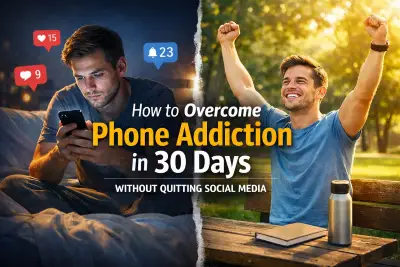
How to Overcome Phone Addiction in 30 Days Without Quitting Social Media
Discover how to overcome phone addiction in 30 days without quitting social media, using simple digital detox steps to reduce screen time and regain focus.
Phone addiction has quietly become one of the biggest productivity and mental health challenges of modern life. Most people don’t realize how often they reach for their phone, how much time they spend scrolling, and how deeply this habit affects focus, sleep, and emotional balance.
If you have tried deleting apps, turning off notifications, or going cold turkey, you already know one thing: willpower alone does not work. You don’t need to quit social media forever. You need a smarter system that trains your brain.
This guide will show you how to overcome phone addiction in 30 days without quitting social media. You will learn how to reduce screen time realistically, use digital detox strategies that fit daily life, and build habits that last.
This approach is based on psychology, habit design, and structured training methods used in programs like the Overcome Phone Addiction Video Upgrade, which provides step-by-step video guidance to break unhealthy phone habits and rebuild focus.
What Is Phone Addiction?
Why smartphones are so addictive
Smartphones are designed to capture and hold attention. Notifications, likes, messages, and infinite scrolling trigger dopamine, the brain’s reward chemical. Each swipe feels harmless, but the brain begins to crave that stimulation.
This is why phone addiction is not about laziness. It is about habit loops:
- Trigger: boredom, stress, or silence
- Action: checking the phone
- Reward: stimulation or distraction
- Repeat: the brain learns the pattern
Over time, this loop becomes automatic.
The difference between normal use and addiction
Using a phone for work, communication, or learning is normal. Phone addiction shows up when:
- You check your phone without thinking
- You feel anxious when it is not nearby
- You lose hours scrolling without meaning to
- Your sleep, focus, or relationships suffer
If your phone controls your attention instead of serving your goals, it is time to reset the habit.
Common Phone Addiction Symptoms
Mental and emotional signs
Many people feel mentally exhausted without knowing why. Phone addiction often causes:
- Short attention span
- Restlessness
- Anxiety when offline
- Low motivation for real-world tasks
The brain becomes trained to expect constant stimulation.
Physical and sleep problems
Too much screen time affects the body as well as the mind:
- Poor sleep quality
- Eye strain
- Headaches
- Neck and shoulder pain
Late-night scrolling keeps the brain active when it should be resting.
Productivity and relationship damage
Phone addiction weakens focus and emotional presence. You may notice:
- Difficulty finishing tasks
- Constant distractions at work
- Less meaningful conversations
- More time online than with people
This creates a cycle of frustration and guilt.
Why Willpower Alone Doesn’t Work
Dopamine and habit loops
The brain is not built for endless choice and stimulation. Each notification reinforces the habit loop. Trying to rely on willpower is like trying to hold your breath forever. It works for a moment and then fails.
To overcome phone addiction, you must redesign the environment and your routines.
Why deleting apps fails
Deleting social media apps often leads to:
- Reinstalling them later
- Switching to web versions
- Feeling deprived
This creates resistance instead of discipline. The goal is not punishment. The goal is control.
How to Reduce Screen Time Step by Step
Step 1 – Awareness tracking
You cannot change what you do not measure. Start by checking your daily screen time. Write down:
- Total hours per day
- Most used apps
- Times of highest use
This reveals patterns and triggers.
Step 2 – Trigger control
Most phone use starts with emotional triggers:
- Boredom
- Stress
- Loneliness
- Procrastination
When you feel the urge, pause and ask: What am I avoiding right now?
Step 3 – Replacement habits
Removing a habit without replacing it leaves a gap. Choose small alternatives:
- Stretching for 2 minutes
- Drinking water
- Reading one page
- Deep breathing
Your brain still gets action without scrolling.
Step 4 – Time boundaries
Create clear phone rules:
- No phone during meals
- No phone one hour before sleep
- Scheduled social media time
Boundaries create structure.
Digital Detox Without Going Extreme
Realistic detox rules
A digital detox does not mean throwing away your phone. It means using it intentionally.
- Keep essential apps
- Limit entertainment apps
- Turn off non-essential notifications
This keeps you connected while reducing addiction.
What to avoid
Avoid extreme plans such as:
- Deleting all apps at once
- Going offline for weeks
- Shaming yourself for mistakes
Sustainable change beats dramatic change.
30-Day Phone Addiction Recovery Plan
Week 1 – Reset habits
Focus on awareness and the environment:
- Track screen time daily
- Remove unnecessary apps
- Turn off most notifications
- Set phone-free zones
This breaks automatic behavior.
Week 2 – Control urges
Now practice replacing urges:
- Use replacement habits
- Delay phone use by 10 minutes
- Practice boredom tolerance
This trains impulse control.
Week 3 – Build focus
Strengthen attention:
- Work in focused blocks
- Keep the phone in another room
- Read or journal daily
Focus becomes a skill again.
Week 4 – Long-term discipline
Create a lifestyle system:
- Weekly screen time review
- Scheduled social media sessions
- Evening offline routine
This prevents relapse.
How Video Training Helps You Break Phone Addiction Faster
Why structured guidance works better
Random tips are easy to forget. Structured training creates accountability and progression. Video lessons help you:
- Understand the psychology behind addiction
- Follow daily steps
- Stay motivated
- Track improvement
This is why many people use guided programs instead of relying on articles alone.
What the Overcome Phone Addiction Video Upgrade teaches
The Overcome Phone Addiction Video Upgrade is designed to help you:
- Reduce screen time naturally
- Break dopamine-driven habits
- Build self-control
- Create a balanced digital lifestyle
It provides step-by-step video lessons and a practical action plan instead of theory.
Final Thoughts: Take Back Control of Your Life
Phone addiction is not a personal failure. It is a habit shaped by technology and psychology. The solution is not quitting social media forever. The solution is learning how to use it without being controlled by it.
In 30 days, you can:
- Reduce screen time
- Sleep better
- Improve focus
- Feel calmer
Reading about how to stop phone addiction is helpful. Taking action is what changes your life.
If you want a guided system that walks you through this transformation, the Overcome Phone Addiction Video Upgrade provides a clear roadmap to break the habit and regain control.
Your phone should be a tool, not a master. The next 30 days can change how you live, work, and think.